Daily Content Archive
(as of Thursday, December 30, 2021)| Word of the Day | |||||||
|---|---|---|---|---|---|---|---|
edacious
| |||||||
| Daily Grammar Lesson | |
|---|---|
Adjective ComplementsAn adjective complement is a phrase or clause that provides information necessary to complete an adjective phrase’s meaning. Adjective complements are similar to but distinct from modifiers of adjectives. How do they differ? More... | |
| Article of the Day | |
|---|---|
 Horsepower IndeedEarly streetcars had horsepower, literally; they were drawn by horses or mules and called "horsecars." By the late 1880s, there were 415 street railway companies in the US. However, horses could only work for about four hours a day and needed to be groomed, fed, and housed—and they left behind tremendous amounts of waste. These issues, coupled with the introduction of the overhead trolley system in 1887, spelled the end of the horsecar era. Where was the last functional horsecar in the US? More... | |
| This Day in History | |
|---|---|
 The Granada Massacre (1066)When Rabbi Samuel ha-Nagid died around the year 1055, his son Joseph succeeded him as leader of the Jewish community of Granada and vizier to the Berber king. At the time, figures in the Muslim community were unhappy with what they believed to be inordinate Jewish political power. Joseph, who was said to be arrogant and ostentatious, in contrast with his father, was eventually assassinated by a Muslim mob in a siege that also claimed 4,000 Jews of Granada. How was Joseph killed? More... | |
| Today's Birthday | |
|---|---|
 Simon Forman (1552)Forman was arguably the most popular occultist, astrologer, and herbalist in Elizabethan London, despite not possessing a medical degree. He kept detailed records of his unorthodox practice, and his diaries have yielded a wealth of historical information—including contemporary accounts of Shakespeare's plays. He was posthumously implicated in a murder plot that tarnished his reputation and has been characterized as either evil or a quack. What 1611 event is he said to have accurately predicted? More... | |
| Quotation of the Day | |
|---|---|
 A common and natural result of an undue respect for the law is, that you may see a file of soldiers ... marching in admirable order over hill and dale to the wars, against their wills, ay, against their common sense and consciences. A common and natural result of an undue respect for the law is, that you may see a file of soldiers ... marching in admirable order over hill and dale to the wars, against their wills, ay, against their common sense and consciences.Henry David Thoreau (1817-1862) | |
| Idiom of the Day | |
|---|---|
up the walls— Extremely busy or overworked; having many things to contend with at once. Primarily heard in UK, Ireland. More... | |
| Today's Holiday | |
|---|---|
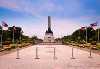 Rizal Day (2021)A national holiday in the Philippines, Rizal Day commemorates the execution of the national hero, Dr. José Rizal, on this day in 1896. Flags fly at half-staff throughout the country, and special rites are led by the president at the 500-foot Rizal Monument in Manila. Writing from Europe and denouncing the corrupt ruling of the Philippines by Spanish friars, Rizal became known as a leader of the Philippine reform movement. He had no direct role in the nationalist insurrection, but he was arrested, tried for sedition, and executed by a firing squad. More... | |
| Word Trivia | |
|---|---|
Today's topic: sailingaloof - Comes from sailing, in which ships keep clear of coastal rocks by holding the vessel "luff"—"to the windward"; so, to hold "a-luff" means to "keep clear." More... jibe - Meaning "be compatible, consistent," it may come from the earlier jibe, "to shift a sail from side to side while sailing in the wind." More... plain sailing - Probably comes from plane sailing, a way of determining a ship's position based on its moving on a plane (flat surface). More... aback - Originated in sailing, as a ship was taken aback when a strong gust of wind suddenly blew the sails back against the mast, causing the ship to stop momentarily. More... | |